Fractured Horizons: Imaging After Images
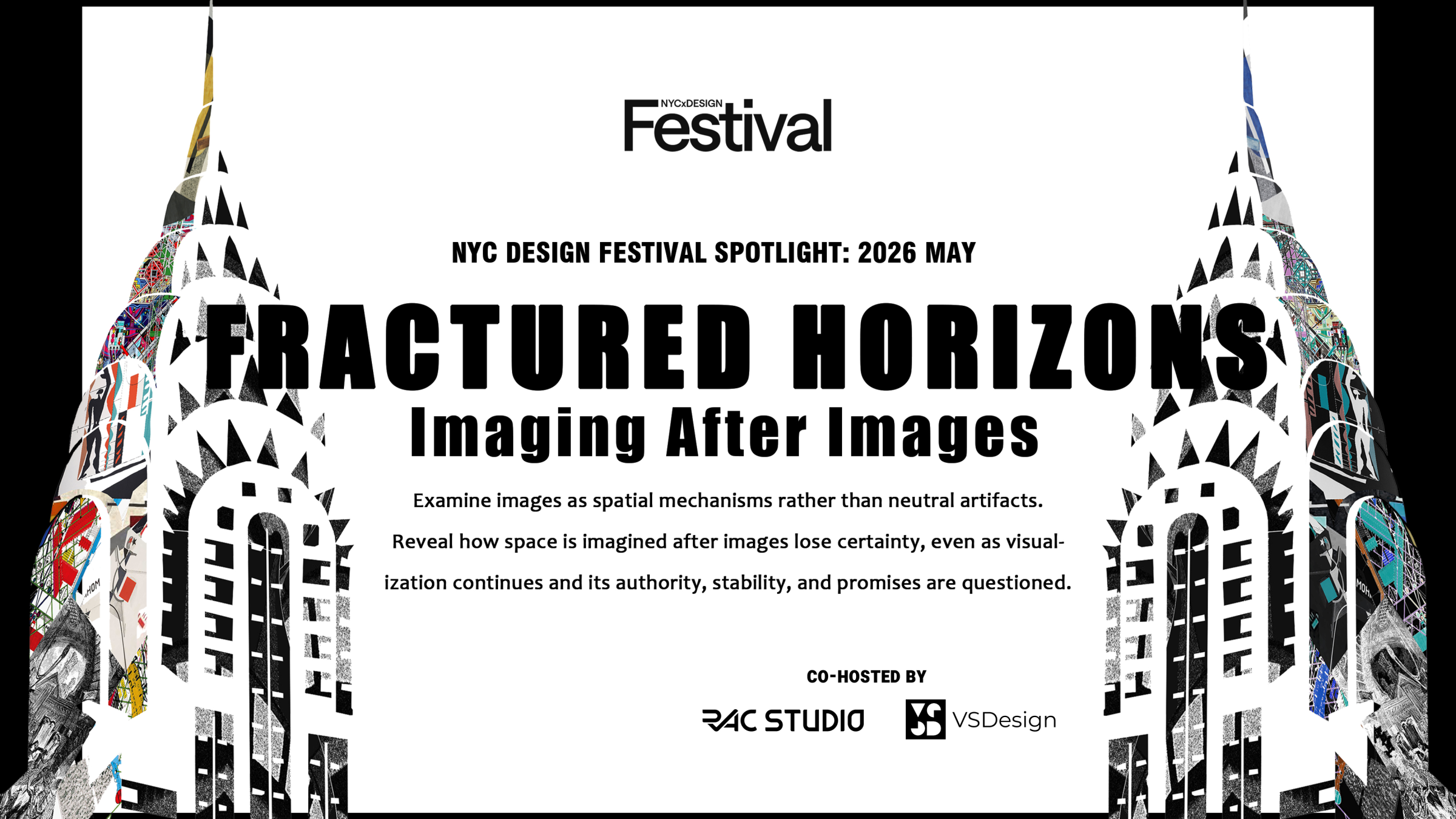
Fractured Horizons: Imaging After Images** built on 2025’s exploration of post-industrial and posthuman futures, examining how images no longer just depict space but actively construct and govern it. Through diverse media, it revealed a fragmented future shaped by AI-driven visualization, shifting authorship, and hidden systems of control and constraint.
Fractured Horizons: Imaging After Images was presented as part of NYCxDESIGN 2026, one of the most influential global platforms for contemporary design. Building on the success of its 2025 edition, which brought together over 70 artists and designers across nine countries, this year’s exhibition advanced an ongoing investigation into post-industrial and posthuman spatial conditions.
Shifting focus from representation to production, Fractured Horizons: Imaging After Images asked a critical question: what happens when images no longer simply depict space, but actively construct, operationalize, and govern it? In an era shaped by computational visualization and generative AI, images have become agents of decision-making, influencing how environments, products, and digital worlds are conceived and realized.
Across architecture, urbanism, product design, visual communication, and interactive media, image-based systems now underpin spatial logic. Interfaces, parameters, resolutions, and predictive models are no longer secondary tools but foundational conditions through which space is imagined and produced. Yet beneath the surface of accessibility and creative democratization lies a deeper entanglement with centralized infrastructures, proprietary datasets, and algorithmic control.
Within this evolving landscape, the exhibition revisited Gilles Deleuze’s concept of “smooth” and “striated” space, not as a fixed opposition but as a fluctuating condition. Images promise fluidity, openness, and infinite variation, while simultaneously encoding constraints, standards, and exclusions. Space, in this sense, is no longer stabilized by physical boundaries alone, but increasingly shaped by visual systems and computational logics.
At the same time, these images carry a layered temporal tension. Nostalgia for industrial modernity coexists with a restless drive toward speculative futures, merging into hybrid visual constructs that are fragmented, provisional, and often contradictory. The future appears less as a singular destination and more as a contested field shaped by overlapping forces.
Co-presented with RAC Studio and Asia Design Week, this year's edition featured the works of 60 artists, including:
Rongrong Chao, Ofen Hu, Pink Blue Black & Orange Co., Ltd., Eric Widjaja, Ira Carella, Ritter Willy Putra, Miko Awangyudha, gemasemesta.co, Yiwei Lin, Jinrong Li, Lingxi Ge, Manming Luo, Fenghan Gao, Linyun Jiang, Siya Xu, Henry Yinghao Liu, Shiyu Ma, Manni Chen, Jingqi Sun, Zihan Lu, Zhengqi Ye, Hongming Zhang, Xiaohang Liu, Danyang Mu, Ren Wei, Zhe Tang, Daiwei Wu, Tiantian Ma, Fanyu Xu, Yue Cui, Jiabao Zhou, Hui Miao, Jiaye Yao, Ming Chen, Eric Ma, Xi He, Shaowen Wang, Ziyi Liu, Kaixin Su, Yinuo Xu, Peiyi Wang, Xinyi Cai, Qiuyue Chen, Jiawei He, Quanling Tan, Fanyi Li, Yifei Zhou, Jiayi Wang, Yifei Wang, Kaiyuan Chen, Xiaoyun Chen, Lifei Wang, Peng Zheng, Yohe Wang, Renjia Wang, Wenjuan Zhou, Weiwei Xiang, Yujia Ke, Yumei Feng, Zhiyong Wang, Ziwei Deng, Jingyi Wang, Wei Kang, Yi Luo, Yuchuan Yu.
Bringing together drawings, models, simulations, moving images, AI-generated works, and hybrid media, the exhibition invited artists and designers to critically engage with images as spatial mechanisms rather than neutral representations. Fractured Horizons: Imaging After Images ultimately proposed a rethinking of spatial imagination in an age where visualization persists, even as its authority becomes increasingly unstable.
Hosted by