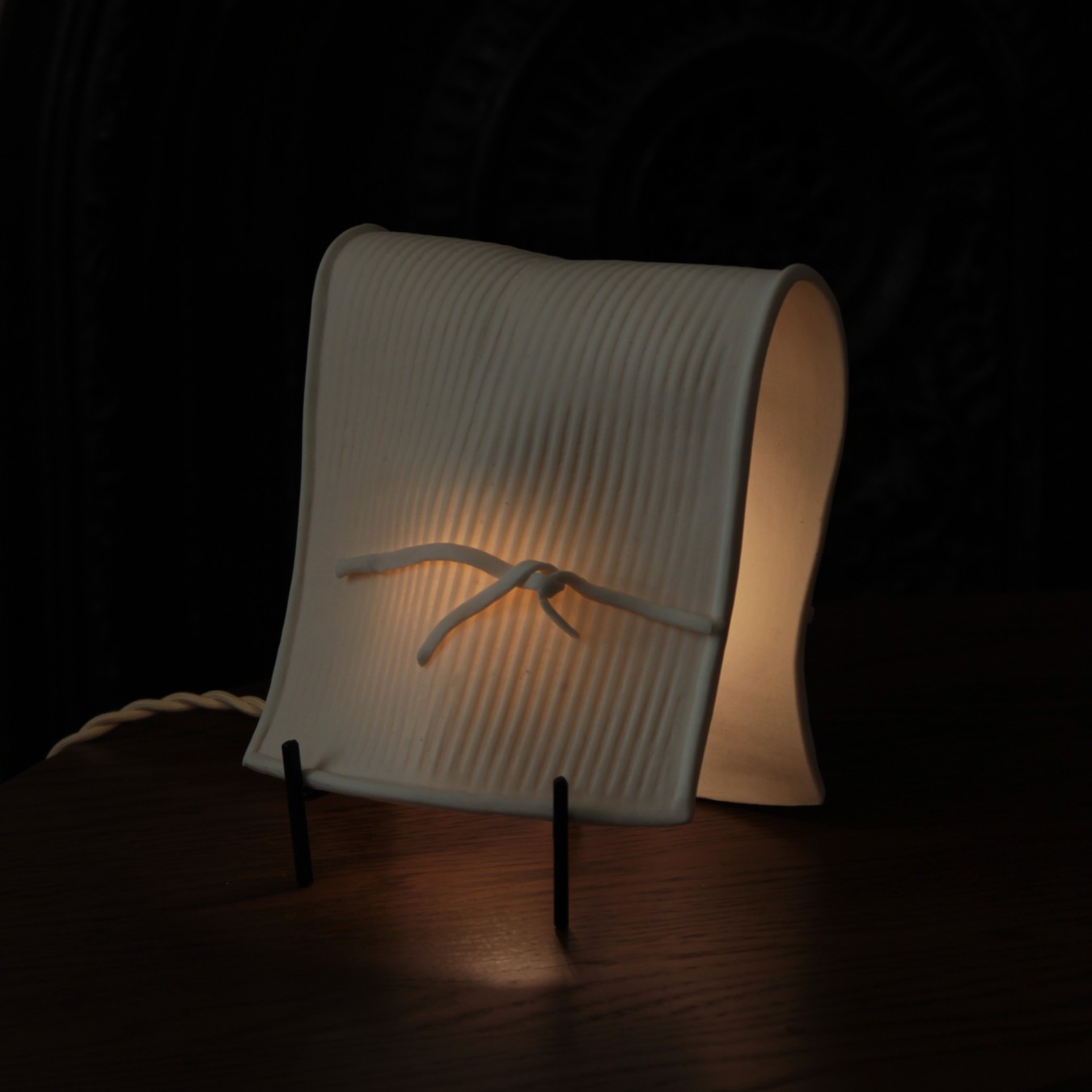
The Altar Lamp is conceived as a domestic monument, offering a site of pause where daily rituals gather meaning.
The Altar lamp features a porcelain shade inspired by the structure of leaves. Naturally translucent yet fragile, the porcelain is reinforced with a ribbed surface and outer lining, giving the shade structural strength and definition. Its form folds into a structural curve, held just above the ground on an iron frame.
Porcelain filters light in a way that holds warmth close to the body. First developed in China, porcelain was refined over centuries into a hard, white, vitrified ceramic body known for its delicacy, strength, and translucency. Traditional hard-paste porcelain is made from kaolin, a white china clay, and petuntse, or china stone, a feldspathic rock that helps the body vitrify at high temperatures. This combination gives porcelain its rare ability to be both thin and strong, allowing light to pass softly through its surface.
During a trip to Jingdezhen and Dehua, two historic centers of Chinese porcelain, Liyang witnessed light passing through porcelain statues of gods. They glowed red, as if blood were moving beneath their surfaces. The Altar Lamp carries this memory forward, treating porcelain not as a static material but as a living presence.
A project by

Liyang Zhang
Liyang Zhang is a Chinese-Canadian architect and ceramic artist, born in Osaka and based in New York City. Her interest in ceramics emerged from a desire to explore the most elemental aspects of architecture, namely light, material, and form, on a more intimate, tactile scale. Her work often arises from a dialogue between hand and material, allowing form to emerge from the clay’s inherent qualities. As a maker, she sees her role as guiding a material to reveal its true nature and inviting its own character and story to emerge.